

It’s 8 p.m. on a Tuesday. A homeowner’s breaker keeps tripping, half the kitchen is dark, and they grab their phone to search for “electrician near me.” Three electrical companies pop up in the map results. You’re licensed, you’re good, and you’re 12 minutes away. But you’re not one of those three, so your phone never rings.
That gap is what electrician local SEO is built to close. It’s the part of search engine optimization that decides whether your business shows up when someone nearby needs electrical work. It isn’t only about your shop’s ZIP code. It covers every town, suburb and neighborhood you’re willing to drive to.
This guide focuses on the local side of SEO for electricians: how Google picks which electricians to show, seven strategies that help you rank across your whole service area, the mistakes that quietly cost visibility, and how long it all realistically takes.
Why Local SEO Matters for Electrical Contractors
Most electrical work is local by nature. Nobody hires an electrician three states away to swap a panel or chase down a dead circuit. So, naturally, when someone searches for electrical help, Google assumes they want a pro nearby.
Local SEO for electrical contractors is how you become one of the businesses it shows.
And the pressure is far higher than it used to be. Customers look at just a handful of options, and the bar to make their shortlist keeps rising. BrightLocal’s 2026 Local Consumer Review Survey found that 68% of consumers will only use a business with at least four stars, up from 55% the year before.
More than half of consumers also visit a business’s website after reading positive reviews. Your Google presence and your website now work as one sales path.
Then there’s the service-area reality. You might work across a dozen towns, but Google tends to rank a business most strongly near its own location. Without a deliberate local strategy, many electricians dominate the few miles around their shop and vanish everywhere else they’d happily take a job.
Search is also spreading beyond the classic results page. The same BrightLocal survey found 45% of consumers now use AI tools like ChatGPT for local business recommendations, up from 6% a year earlier.
Those tools pull from the same signals local SEO builds: your business profile, reviews, listings and website. Getting local SEO right also lays the groundwork for answer engine optimization.
How Google Determines Which Electricians Appear in Local Searches
Google doesn’t publish its local algorithm, but it does explain the basics. Its guide to local ranking says local results come down mainly to three things:
- Relevance: How well your Business Profile matches what someone searched. If they type “EV charger installation” and your profile only says “electrician,” Google has less to work with.
- Distance: How far your business is from the person searching. You can’t move your shop, but you can make your service area crystal clear.
- Prominence: How well known and trusted your business is. Google points to reviews, ratings and links from other websites as part of this. (Its help page now also calls this “popularity.”)
Google also states plainly that there’s no way to pay for a better local ranking. Ads can buy a spot at the top of the page, but the map results are earned.
Beyond those three pillars, the local search experts surveyed in Whitespark’s 2026 Local Search Ranking Factors report point to a few signals that matter a lot for electricians:
- Your primary category ranked as the single most important local factor.
- Being open at the time of the search jumped straight to #5 as a newly added factor. A 9 p.m. search may favor electricians whose listed hours are open right then.
- Google’s predefined services on your profile climbed to #22, up from near the bottom of the list in 2023.
- Review rating, volume and recency all landed in the top 11.
Why your ranking changes from one street to the next
Because distance is measured from the searcher, there’s no single “rank” for your business. A homeowner searching from the next block over may see you first. Someone 20 minutes away, in a town you serve every week, may not see you at all.
That’s why good local SEO for electricians isn’t about one keyword in one city. It’s about pushing your visibility outward across the whole area you actually work.
7 Local SEO Strategies for Electricians
Think of these as wiring a circuit. Each piece matters on its own, but the results come when everything is connected in the right order.
1. Optimize Your Google Business Profile
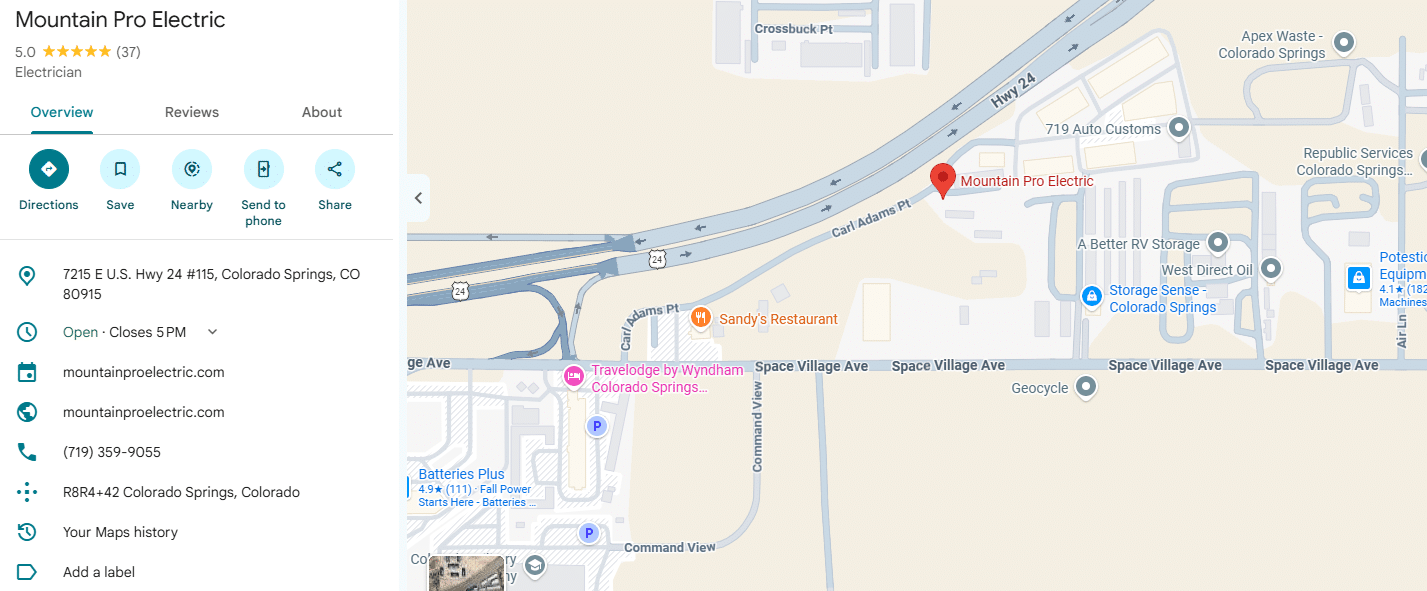
If you haven’t claimed and verified your profile yet, start with our guide to setting up your Google Business Profile. Once it’s live, these settings do the most to move local rankings:
- Pick the right primary category. For most shops, that’s “Electrician.” Add secondary categories only for work you really do, such as “Electrical installation service” or “Lighting contractor.”
- Fill in Google’s suggested services first. Google offers predefined services for electricians. Check every one that applies, then add custom services for the rest: panel upgrades, EV charger installation, whole-home rewiring, generator hookups, ceiling fan installation.
- Set up your service area correctly. If customers don’t come to your shop, Google’s service area rules say to remove your address from the profile. You can then list up to 20 cities, ZIP codes or similar areas, ideally within about a two-hour drive of your base.
- List your real hours. Since being open at search time affects visibility, accurate hours matter. If you staff after-hours emergency calls, show that. If you don’t, don’t claim 24/7.
- Upload real photos regularly. Trucks, crews, clean panel installs, finished lighting projects. Skip stock images.
- Keep your business name clean. Use your real business name only. Adding “Best Emergency Electrician Denver” breaks Google’s guidelines and can get your profile suspended.
One recent change worth knowing: Google retired the old Q&A section on Business Profiles. In its place, an AI-powered “Ask” feature in Google Maps answers customer questions using your profile, reviews and website. The more complete those are, the better those answers will be.
2. Build Dedicated Electrical Service Pages
In Whitespark’s 2026 survey, a dedicated page for each service was rated the #1 factor for local organic rankings. One “Services” page on your website listing everything you do won’t compete with a competitor who has a full page on panel upgrades, EV charger installations, outlet and switch wiring, attic fans, and so on.
A strong electrical service page, using a panel upgrade as the example, should cover:
- Who needs it, and the warning signs (frequent breaker trips, flickering lights, a 100-amp panel in a home adding an EV charger)
- What the process looks like, from assessment to final inspection
- Permits and inspections, and who handles them
- Typical timeline
- Your license number and insurance
- Photos of your own completed work
- Service-specific FAQs
- A clear way to call or request a quote
Those FAQs pull double duty now that Google’s Q&A section is gone. Clear answers on your website give Google’s AI tools something accurate to pull from.
If your current site makes this hard to build, it may be time to rethink your electrician website structure.
3. Target Electrical Services and Local Keywords
A good SEO strategy for electricians starts with the way real customers search. They rarely type “electrical contractor.” They type the problem or the job.
Group your keywords by job type, then pair them with the places you serve:
| Search intent | Example searches | Best page to target it |
| Emergency | “emergency electrician,” “electrician open now,” “power outage in half my house” | Emergency service page + Business Profile |
| Upgrades | “200 amp panel upgrade,” “EV charger installation,” “home generator installation” | Individual service pages |
| Safety and repairs | “electrical inspection,” “knob and tube wiring replacement,” “outlet not working” | Service pages + helpful blog posts |
| Commercial | “commercial electrician,” “tenant improvement electrical” | Commercial service page |
| Location-led | “electrician in [town],” “[town] panel upgrade” | Service area pages |
You don’t need to force “near me” into your copy. Google already reads local intent from where the searcher is. Focus on clear service and location language, and use our on-page SEO basics for electrician websites for where those keywords belong on each page.
4. Create Service Area Content for Communities You Actually Serve
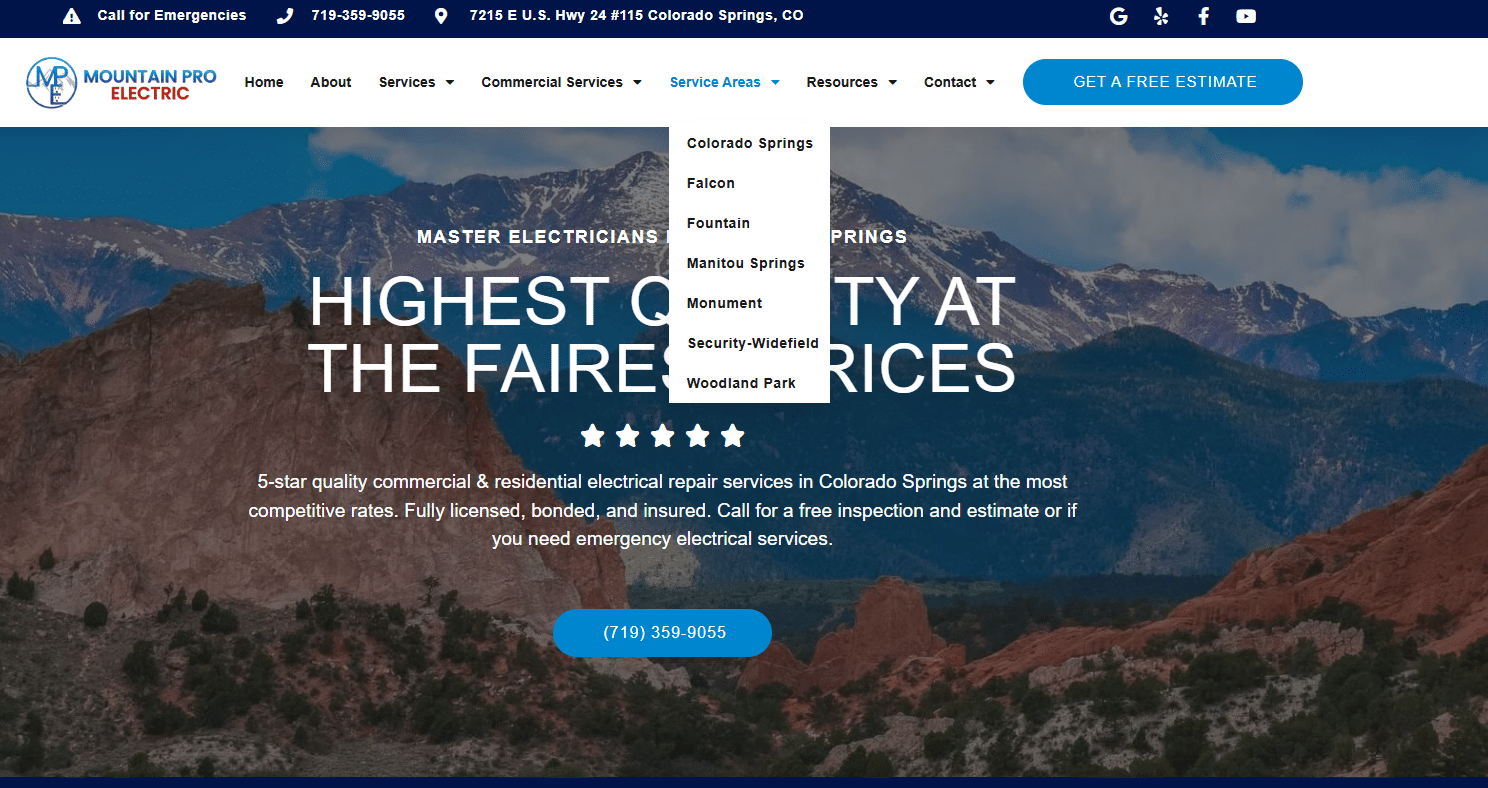
This is where many electricians either break through or get burned.
Pages for the towns you serve can help you rank beyond your home base. But copying one page 30 times and swapping the city name is a different story.
Google’s spam policies call out “doorway” pages: near-identical pages built to rank for different locations that all lead visitors to the same place. These pages rarely help, and a whole batch of them can drag your site down.
A service area page earns its place when it holds details only a local electrician would know:
- Real jobs you’ve done there, with photos (“Service upgrade on a 1960s ranch in Lakewood”)
- What’s common in that area’s homes, like older housing stock that needs panel replacements, or new builds pre-wiring for EV chargers
- The local permitting office or inspection process
- Reviews from customers in that town
- Neighborhoods you cover and your typical response time
Start with three to five towns where you already get steady work. Build those well, then expand. Five useful pages will outperform 25 clones.
5. Build Consistent Local Citations
Citations are listings of your business name, address and phone number (often shortened to NAP) on other websites. They help Google confirm you’re a real, established business, and that information should match everywhere.
Beyond the usual directories, focus on the places that matter for electricians:
- The big map platforms: Google, Apple Maps and Bing Places. BrightLocal found that Apple Maps use for reviews nearly doubled in a year, from 14% to 27% of consumers.
- Trade and home-service sites: Angi, the Better Business Bureau, your local chamber of commerce and home-builder associations.
- Supplier and manufacturer directories: Many equipment makers and suppliers list certified installers.
Citations have picked up new importance with AI search. In Whitespark’s 2026 report, three of the top five factors for AI search visibility were citation factors.
If you’re not sure where your listings stand, a free local listings audit can show you where things don’t match.
6. Earn Relevant Customer Reviews
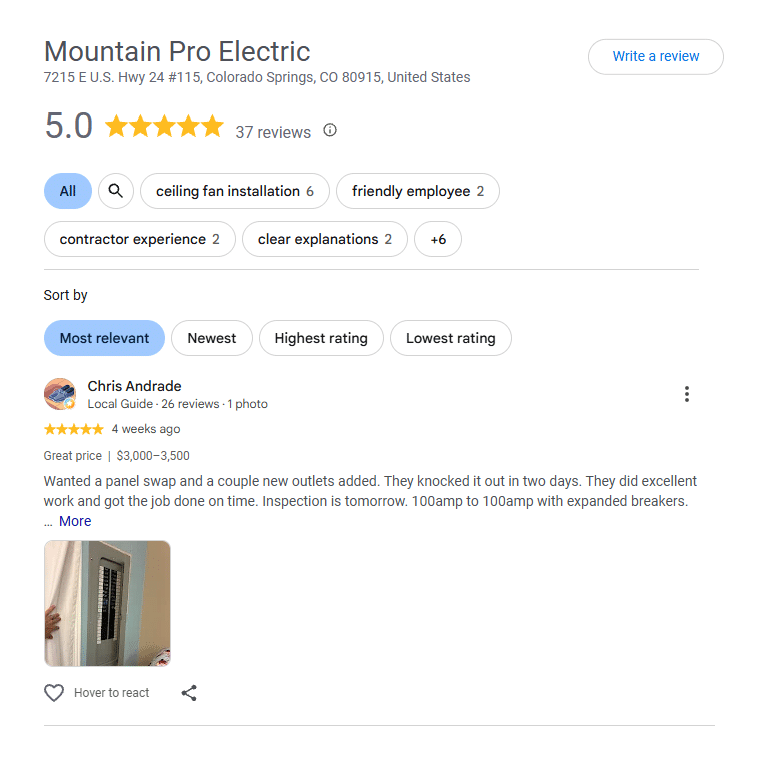
Reviews are one of the strongest prominence signals you can influence. For local rankings, three things matter most:
- Recency: Whitespark’s experts ranked review recency #11 among local pack factors, and BrightLocal found 74% of consumers only care about reviews from the last three months.
- Steady flow: A consistent trickle of reviews beats a big burst followed by silence.
- Specifics: A review that mentions “panel upgrade in Arvada” tells Google and future customers more than “great job.”
Never buy reviews or offer rewards for positive ones. Both break Google’s rules, and incentivizing positive reviews can run afoul of the FTC’s rule on fake reviews.
For scripts, timing and follow-ups, use our guide to build a simple review system.
7. Track Rankings, Website Traffic, and Leads
Since your ranking changes depending on where the searcher stands, one rank-check from your office desk can be misleading. Use a grid-based rank tracker instead. It checks your map ranking from dozens of points across your service area and shows where you’re strong and where you fade.
Alongside rankings, track the numbers that pay the bills:
- Google Business Profile performance: calls, website clicks and direction requests
- Google Search Console: which service searches bring impressions and clicks
- Calls and form fills: tagged by job type, so you know whether SEO is bringing panel upgrades or $90 outlet repairs
- Reviews: total count, average rating and new reviews per month
If visibility rises but calls don’t, look at your profile and page messaging. If calls rise but booked jobs don’t, look at how leads are handled once the phone rings.
Common Local SEO Mistakes Electricians Should Avoid
Some mistakes slow your progress. Others can get your Business Profile suspended. These are the ones we see most often with electrical contractors.
Stuffing keywords alongside your business name
“Smith Electric” is a business name. “Smith Electric | Emergency Electrician | Panel Upgrades Denver” is a suspension risk. Google’s guidelines say extra words in the name aren’t allowed. Put that detail in your services, website and posts instead.
Showing your home address
If customers don’t visit your location, hide the address and use service areas instead. Showing a home or unstaffed office address when you’re a service-area business breaks Google’s rules. Never use a P.O. box or virtual office address either.
Listing every town you could possibly reach
Twenty service areas is a limit, not a goal. Listing towns you rarely visit, or stretching beyond about a two-hour drive, won’t make you rank there. It just blurs the picture of where you actually work.
Cloning city pages
Thirty identical pages with a different town name in each heading is the classic doorway-page pattern. Build fewer pages with real local substance instead.
Claiming hours you don’t keep
Open hours influence when you show up, which makes “24/7” tempting. If nobody answers at 2 a.m., you’ll earn frustrated callers and bad reviews, and you’ll be outside Google’s guidelines.
Following outdated advice
Plenty of guides still say to seed your profile’s Q&A section or turn on Business Profile chat. Both features are gone. If an article tells you to do something you can’t find in your profile anymore, check its publish date.
Treating SEO as a one-time project
Competitors keep collecting reviews, adding photos and publishing pages. A profile that was strong two years ago can slide quietly if nobody tends it.
How Long Does Local SEO Take for Electricians?
Most electricians see early movement within the first one to three months. Bigger, steadier gains usually build over three to six months and beyond. The exact pace depends on your market, your starting point and how far from your base you want to rank.
Here’s how it typically unfolds:
- Weeks 1–4: Fix the foundation. Correct categories, services, hours and service areas. Clean up listings that don’t match. Changes like these can register fairly quickly because they remove confusion.
- Months 2–3: Early map movement. With a sharper profile and a steady flow of new reviews, rankings usually improve first near your base and for your most specific services.
- Months 4–6 and beyond: Expand your reach. Service pages, service area content and local mentions take longer to build and longer for Google to trust. This is the stage that pushes visibility into the outer towns of your service area.
A few things speed it up or slow it down. Dense metro areas with dozens of established shops take longer than smaller towns. A brand-new profile has more ground to cover than one with years of history. And the farther a town is from your base, the more effort it takes to rank there.
The good news: local SEO compounds. The pages, reviews and listings you build this year keep working next year, which paid ads can’t say.
What Local SEO Progress Looks Like for an Electrical Contractor
To make this concrete, picture a hypothetical example: a three-truck residential electrician based on one edge of a metro area. They get plenty of calls from their own suburb but almost none from the bigger towns 15 to 25 minutes away, where most new construction and panel-upgrade work is happening.
A grid scan of their map rankings shows the problem: strong green around the shop, red everywhere else. Their profile uses a secondary category as the primary, lists three services, shows a home address and has had two new reviews in six months.
Here’s the order they’d tackle it:
- Month 1: Switch the primary category to “Electrician,” add every relevant predefined service, hide the address and set service areas to the eight towns they really serve. Fix mismatched listings on Apple Maps, Bing and Angi.
- Months 1–3: Start asking every customer for a review by text the day the job wraps, and add new job photos each week.
- Months 2–4: Publish dedicated pages for panel upgrades, EV charger installation and generator installs, each with real photos and FAQs.
- Months 3–6: Build service area pages for the three target towns, each featuring local jobs and reviews from that town.
What changes first is usually the middle ring of the grid, the towns just beyond the shop’s home turf. The outer towns follow more slowly as service pages and local content gain trust. The win isn’t one magic ranking. It’s more of the service area turning green, and more calls for the higher-value jobs those pages target.
Get More Electrical Service Leads With Local SEO
If your phone is busy in your own backyard but quiet everywhere else you’d happily drive, that’s a local SEO problem, and it’s a fixable one. At Succeeding Small, we help electricians and other trades bridge the gap between algorithm and audience, with electrician SEO built around how your customers search and how Google ranks local businesses.
That includes Google Business Profile strategy, service and service area pages that hold up to Google’s spam policies, citation cleanup, and local SEO reporting tied to real calls, not vanity rankings. Ready to light up more of your service area? Request a strategy session with our team today.
You can see how we’ve done it in our HVAC company case study.
Frequently Asked Questions About Electrician Local SEO
What is electrician local SEO?
Electrician local SEO is the process of improving your visibility in Google’s map results and location-based searches, like “electrician near me” or “panel upgrade in [town].” It focuses on your Google Business Profile, reviews, listings and location-specific website content.
Can I rank in towns where I don’t have an office?
Yes, though it takes more work than ranking near your base. Clear service areas on your profile, well-built service area pages, reviews from customers in those towns and local mentions all help. Distance still matters, so expect your strongest results closest to where you’re based.
How many service areas should I add to my Google Business Profile?
Google allows up to 20, but more isn’t better. List the towns or ZIP codes you serve regularly, within about a two-hour drive of your base. Adding areas you rarely visit won’t make you rank there.
Should I show my home address on Google?
No, not if customers don’t come to you. Google requires service-area businesses to remove their address from the public profile. Your address is still used privately for verification.
Do I need a separate website page for every city I serve?
Not for every city. Start with dedicated pages for the few towns where you do the most work, and make each one unique with real jobs, photos and local details. Near-identical city pages can hurt more than they help.
Does listing 24-hour availability help my rankings?
Being open at the time of a search can help you show up, so accurate hours matter. But only list 24/7 hours if someone really answers emergency calls around the clock. Misleading hours break Google’s guidelines and lead to unhappy callers.
What’s the difference between local SEO and Local Services Ads?
Local Services Ads are paid listings, often shown with a Google verification badge, at the very top of the page. Local SEO earns your spot in the free map and organic results. Many electricians use both: ads for fast leads and local SEO for steady, long-term visibility.


